





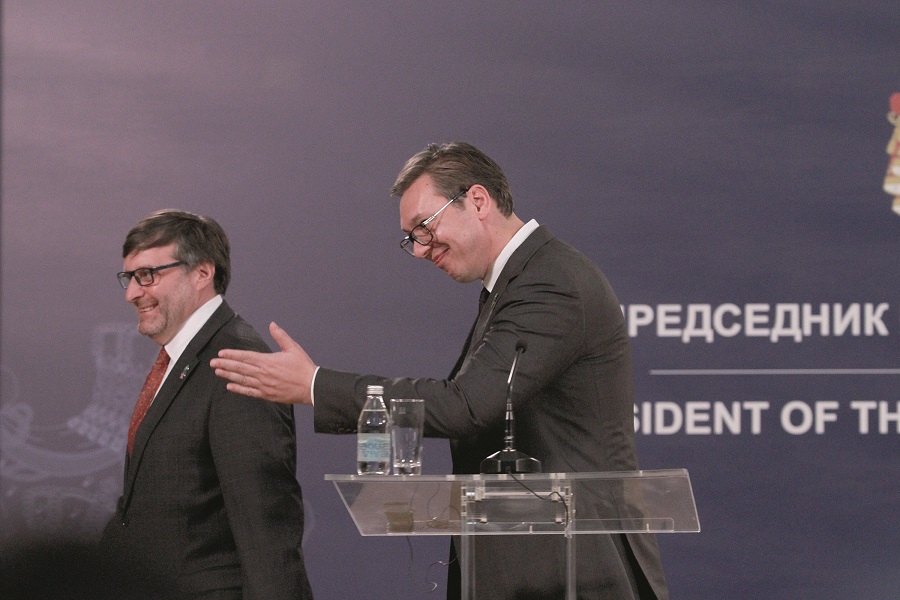

The Trump administration has decided it is time to re-engage with the Balkans. In August last year the Deputy Assistant Secretary of State, August Matthew Palmer was appointed as the special representative for Western Balkans. He has been charged with helping to integrate the countries of the Western Balkans into Western institutions. Palmer has some experience in the Balkans. The administration also appointed the current U.S. Ambassador to Germany, Richard Grenell, as a Special Envoy to the Western Balkans for negotiations between Serbia and Kosovo. Grenell is an advocate for Trump’s foreign policy, has been a controversial Ambassador to Germany, being accused of interfering in the sovereignty of Germany. Grenell has no experience in the Balkans. Whether they have experience in the Balkans or not, both men are tied to the State Department’s hide-bound policies which have not changed in 25 years.
In addition, the sub-committee on Europe and Regional Security Cooperation of the Senate Foreign Relations Committee has re-joined the American commitment to the Balkans. In October of this year the sub-committee held hearings on the Balkans, focusing on Bosnia. Three people testified at those hearings and each one held exactly the same view on why Bosnia has not moved in the direction favored by Washington. Each of them specifically blamed Milorad Dodik, a member of the tri-partite presidency, for the Bosnia’s “failure” to “move forward.” Palmer testified, as did Janusz Bugajski,a Senior Fellow at the Center for European Policy Analysis in Washington. The third person was Majda Idrizdegovic Ruge, a professor at the European University Institute in Florence Italy. Ruge was born and raised as a Muslim in Bosnia.
The Imperial Game
Much of the modern history of the Balkans must be understood through the prism of the history of the great imperial powers of the past and later the imperial interests of the United States. The Balkans is where the great imperial powers met and often fought; it was a geographic border land for the competing aspirations of Austria-Hungary, Russia, the Ottomans, and, although they did not physically border the Balkans, Prussia/Germany, France and Britain also played the game. In the parlance of the late 19th century this was referred to the “Eastern Question.” For Britain and France the Eastern Question became a serious concern because of the policies of Russia and The Ottoman Empire in southeastern Europe. The policies and wars that ensued in the Balkans among the great powers had little or nothing to do with the Balkans themselves; they had everything to do with great power competition.
Arguably, the U.S. became an imperial country as early as the beginning of the 19th century. Although the U.S. played an important role in Europe during the First and Second World Wars, American imperial ambitions did not focus on Europe in a serious way until the 1990s when the U.S. entered the Balkans, albeit in the guise of “helping” the region get past the bloody wars of the succession of the second Yugoslavia. To understand why and how the U.S. became an imperial power very early in its history and then later in the Balkans it is necessary to understand what drives American foreign policy. From the foundations of the U.S. in the late 18th century until today the U.S. has seen itself as a “special nation.” Most American leaders have seen the country as a “light on a hill,” as the “indispensable” nation. As such, many American leaders have believed that the U.S. has been appointed by God himself to “save” the world by spreading democracy around the globe, especially to people whom they believe are not capable of governing themselves.
It is with this attitude that the U.S. entered the wars of Balkan succession in 1993. When those wars ended in 1995 with the signing of the Dayton Accords, the U.S. thought that it had brought peace, prosperity and democracy to Bosnia and throughout the Balkans. The U.S. became less interested in the region after Dayton until 1999 when the Bush administration felt it necessary to “save” Kosovo and to recognize Kosovo as an independent state. For the next 20 years Washington again has paid little attention to the region, assuming that its “noble” work of democratic state building had succeeded. But, it has become clear that the American effort in the Balkans has been far from successful and Washington has come to believe now that much more work needs to be done.
So, there have been several calls over the past few years for the U.S. to re-engage in the Balkans on the mistaken assumption that Washington has answers to the complicated issues of the region. But, Washington does not have answers and is really not especially interested in the Balkans per se or the people of the Balkans. The Trump administration is interested in returning to the Balkans for two major reasons. First, because the region has not followed American dictates during the past 25 years and Washington believes that the only way the Balkans can move ahead is to follow what the U.S. says. Second, Washington is interested in the Balkans because the Russians are there. The U.S. and Russia have returned to the region to pursue intelligence, diplomatic, political and security activities against each other. Both countries are using the Balkans as a primary region to spy on each other and to conduct counter-espionage and other clandestine activities against each other. At the same time, they are conducting open propaganda and security operations against each other. The issue of Kosovo is important to Washington—and Moscow—not because they are interested in the welfare of Kosovo, but because they are interested in outflanking each other.
The Supplicant
Belgrade has done almost nothing to bring the Kosovo issue to a successful conclusion and to nprotecting Serbia’s national interest. In April 2013 Serbia and Kosovo signed the Brussels Agreement and in 15 short paragraphs, Serbia undermined its own national interests and ensured that Pristina would be able to extend a significant degree of de facto sovereignty over Kosovo. The first 6 paragraphs concern the establishment of the Community of Serb Municipalities. This proposal, which is eerily similar to the debunked Ahtisaari Plan, is on the verge of failure because of a disagreement on the level of power of the Serb Municipalities. In paragraphs 7 through 9, Belgrade agreed to the establishment of one police force for all of Kosovo, thereby guaranteeing that Pristina has the right to exercise police power in Serb communities. Paragraph 11 guaranteed that elections would be help throughout Kosovo—including in Serb municipalities—under Kosovo law. The final paragraphs deal with “technical” competencies, such as energy and telecommunications, which assign significant authority—and, therefore, sovereignty—to Pristina over these areas.
Although the Brussels process has stalled, Serbian leaders continue to undermine their own cause and show a lack of leadership. For example, according to a recent press article, Serbian President Vucic has complained that “no one has offered a solution for Kosovo.” And, in a television interview, he reportedly said “I am doubtful and pessimistic about an agreement (on Kosovo). We will always be for compromise, but I do not see one at this time.” Yet, last year he said he was “obsessed with Kosovo.” If the President is so “obsessed with Kosovo” why does he not use every tool at his disposal to find a solution to the Kosovo mess rather than resigning himself to defeat. Unfortunately, Vucic’s defeatism is typical of the attitude of many Serbian leaders. It is not uncommon to hear Serbian leaders argue that Serbia is “too weak and small” to have a major impact on important matters of national interest, especially Kosovo. There is a constant plea in Belgrade—“what does Washington want, what does Brussels want.” Instead Serb leaders should be asking “what do we want”? While Serbia is, indeed, a small country, this does not mean Belgrade is incapable of forging is own way forward.
This attitude may very well be a psychological response to centuries of dominance by foreign powers. It is in that vein that Vucic and others have welcomed the appointments of Palmer and Grenell as well as the announcement that the EU also will appoint a special representative for the Western Balkans. Acceptance of these Western diplomates is a way for Serbian leaders to avoid the hard work of actually finding a compromise and accepting responsibility. Part of the rational for this lack of responsibility is the fear that too vigorous a position by Belgrade will damage Serbia’s chances for full membership in the EU, although French President Macron’s veto of accession talks with Albania and North Macedonia may already have dealt Serbia a fatal blow.
A Place to Start?
If President Vucic, Deputy Prime Minister Dacic and others are really interested in compromise, let me recommend the following as a place to start.
First, the government in Belgrade has to formally renounce the Brussels Agreement. Adherence to it not only has not served Serbia’s national interests, it has not led to resolution of the Kosovo issue. Second, Belgrade has to deal directly with Pristina on a one-to-one basis. The great powers, especially the U.S., should not be involved because they are interested primarily in their own interests and because their involvement has been an unmitigated failure in the past and there is no reason to assume they will be any more successful in guiding Serbia and Kosovo to a resolution of their mutual problem.
If Belgrade and Pristina can agree on face-to-face negotiations, it might be possible to find a mutually beneficial, true compromise. They can start with the understanding that both sides will have to give up some valued positions and that there will be “malcontents” both in Serbia and Kosovo who will not accept any proposed compromise. They must be side-lined and contained.
The substance of a proposed compromise could go something like this. An international boundary should be drawn at the Ibar River. Everything to the north belongs to Serbia and everything to the south belongs to an independent Kosovo. The majority of Serbs in Kosovo live south of the Ibar, so any Serbs who did not remain under Kosovar control can chose to be moved north of the Ibar River—paid for and organized by the United Nations, the OSCE, the EU or some combination of the three. Likewise, any Kosovars in the north who do not want to live under Serbian control should have the right to move to the south—paid for in the same way that the Serbs would be moved. The U.N., OSCE, EU—or all three—would establish by treaty a mechanism to periodically inspect the communities for those Serbs in the south who want to remain under Kosovar control and those Kosovars in the north who want to remain under Serb control to ensure they are not being discriminated against in housing, jobs, religion, etc. Appropriate fines and convictions would be levied if violations are found either in the north or the south. Serb holy, cultural and historic sites in Kosovo would be accorded the same protections.
In the spirit of true compromise and reconciliation, it also would be reasonable to allow referenda in several areas of the Presevo Valley to determine whether they should be united with Kosovo and in the Republika Srpska (RS) to see if it should be united with Serbia. Of course, any unification of portions of the Presevo Valley with Kosovo and the RS with Serbia would be subject to referenda in Kosovo and Serbia.
Although this is not a perfect solution, it could be a beginning. But, to work, Serbia and Kosovo will need bold, brave, resolute leaders who are really interested in compromise.
Tagovi


